The Fear Bit Me | Kung Fu Panda Fan Fiction | Part 1 (Text Adventure Game In the works)
- Cutie Pie T.T.V.

- Jan 10
- 16 min read

Let's say she's a Chinese goose.
A goose is a prey animal, while Tai Lung is a predator. In the short film backstories, it is clear that prey animals are genuinely wary of predator animals, including figures like Tigress. Because of this, the goose hesitates. She may dream of marrying him, dazzled by the idea of the Dragon Warrior—special, admired, and revered—but marriage would end his title. Marrying her would place her in danger, and he knows it. He has worked too hard to reach this position to give it up.
Instead, he considers simply asking her out, choosing to date rather than marry. Even that feels uncertain. He knows the cost, and he is unwilling to lose his title. When he finally speaks to her, she understands the risks immediately. She knows he could lose everything, that the town would have to protect her, and that he is a predator animal. Still, she is starstruck. After a moment, she says she will think about it and returns home to tell her family that he is interested in her.

Her family, however, are Chinese geese. Beyond the emotional concerns, there are practical ones: two different species cannot truly interbreed. While there may have been an interspecies marriage somewhere in the story’s world, her parents do not see this as comparable. As they gently but firmly explain, “As nice as that is, that is not a cuddly panda nor a gander.” A gander is a male goose.

Her mother, An Qi (安琪)—meaning “Peaceful and graceful”—listens carefully before responding. The daughter is Li Mei (丽梅), meaning “Beautiful plum,” and her father is Liang Yu (良宇), meaning “Good and vast.” An Qi speaks with measured honesty, saying, “As good as you think this is, this is the Dragon Warrior. If you marry him, he will lose his role. You will have to be with him without marriage in order for him to keep this role.”
She continues, explaining that "Sex outside of wedlock has traditionally been unacceptable in Chinese culture." While modern views vary by generation, region, and family, Confucian values emphasize sexual activity within marriage to preserve lineage and social order. Sex outside of marriage is often seen as dishonoring the family, disrupting society, and—especially for women—carrying deep shame under a strict double standard.
An Qi’s tone hardens as she adds, “And you are probably going to be convinced to live with this man outside of marriage, which can lead to him trying to mate with you outside of marriage. I do not approve of such shame. And With the level of pride he has—as he is very prideful, very entitled—I cannot approve. He is a great protector, but not a great person. I must be honest, I do not approve.”
She goes on, “Yes, Some rich people keep concubines, but that would reflect badly on the family. He will not marry you. You will not have a husband. Plus, You will not have the same kind of security as you would with a man without so many enemies, unlike him. You will be a target. He has enemies—many enemies—and not all of them are evil. Some are simply people he has wronged for no reason. He is an entitled jerk. It is not that I dislike him, but this will be very bad. You will be with someone who will not marry you, who will embarrass you, who will bring shame upon this family. I would love to elevate this family with a son-inlaw that is the Dragon Warrior, but this is risky. He will bring trouble to you, because he is, quite simply, a jerk.”
The room falls quiet after her words, heavy with concern, tradition, and a mother’s fierce need to protect her daughter from a future filled with danger and dishonor.

Her father did not fully agree. He spoke carefully, weighing each concern aloud...
“Well, technically, he is the Dragon Warrior. Mating outside of wedlock wouldn’t bring shame upon the family. Even if he sleeps with her, people will still respect him. But he has many enemies—some of them not truly dangerous, just people he doesn’t get along with. He carries himself as if he is better than everyone, and not everyone likes him. That worries me.”
He paused, then continued...
“If you desire marriage and never receive it, that alone creates a problem. But what concerns me most is the species issue. If you marry this man, since he is a different species... Um... Let's be fair, I have never seen two separate species marry and produce children. For reasons I do not understand, when two species come together, they never have children. You could be with this man for your entire life and never produce a child, never produce an heir. That matters deeply to lineage. You are our only child, our only daughter. Due to other reasons as well, out of love, I am driven to admit that I do not approve.”
Later, I researched the cultural context. In traditional Chinese culture, parental objections like these carried enormous weight. Such concerns would strongly discourage—often end—a relationship, even if the man was powerful or prestigious. In ancient China, and even later periods, marriage was not merely personal; it was familial and social. Parents held decisive authority. When both parents raised serious, rational objections—lineage, safety, shame, or instability—a dutiful daughter would feel morally obligated to step back, even if she felt attraction.
Under Confucian norms, the imbalance of risk was stark. A man losing a title was unfortunate. A woman losing her reputation was devastating. If a relationship could exist only without marriage, all social risk fell on her: living with a man who would not marry her, being viewed as a concubine or mistress, and bringing shame upon her parents. That alone would force her to reconsider, even if she had initially been starstruck.
The safety concerns were also legitimate and persuasive. He had enemies. She would become a target. His role placed any spouse in danger.
Then there was the matter of lineage. Being an only daughter made expectations especially rigid—marriage, children, and continuation of the family line were not optional ideals but obligations. If interspecies unions historically did not produce children, that fact alone constituted a serious cultural strike against the relationship. In traditional values, love did not outweigh lineage.
The conclusion was unavoidable.The relationship was doomed.
Li Mei begins to understand that marriage may be impossible as her father raises further concerns, speaking with a gravity that forces her to listen.
“There is something else you must consider,” he says. “If he eats meat—even if it is only the flesh of those already dead, surgical remains, or body parts removed during embalming—could you live with that? Could you truly endure it?”
He pauses, then continues more pointedly...
“Some animals he eats are sentient. Could you sit beside him and accept that as a prey animal? You are a goose. Your diet is mostly plant-based—grass, seeds, roots, leaves, berries. Yes, geese sometimes eat insects or small fish, but you are not a carnivore.”
His voice tightens...
“Could you prepare a meal for him knowing it is the remains of someone’s dead loved one? Or a prisoner put to death and fed to carnivores? Could you endure the justifications—‘I am a carnivore, I must eat, I will die if I do not’? And if you object, could you handle him growing angry? Yelling at you?”
He shakes his head slowly.
Liang Yu (良宇): “I do not think you could. I do not think you are capable of that. And could you ever be expected to serve him goose? Could you live knowing he is capable of killing innocents when he lashes out? Because he is capable. What if he lashes out at you? What if he eats you?”
His tone softens, but the words remain severe...
“Yes, some of us eat small fish, but we are prey. That is the truth. This is why I do not approve. This concern is valid. I believe this relationship is doomed. I do not trust him with your safety. I do not want you hurt.”
He exhales.
Liang Yu (良宇): “I would rather you marry within your own species. It would secure your safety and our lineage. Morally, you would have no conflict. It is easier to marry an herbivore than a carnivore—or at least someone who shares your values. If you do not wish to eat meat, if you do not wish to consume other sentient beings, you would never be forced to.”
These words unsettle Li Mei. She had been starstruck at first, dazzled by the idea of him, convinced he was admirable and extraordinary. But now doubt creeps in. She begins to question her own feelings.
What if I am prey to him? she wonders. What if I am being hunted?
She realizes that being with him might require her to participate in acts that deeply unsettle her, things she knows she could not endure. The thought alone makes her uncomfortable, frightened even. She understands that if she were forced to accept even half of what her father described, the marriage would collapse.
Slowly, painfully, she comes to a conclusion: for her safety, for lineage, and because marriage may never truly be possible—and because her desire was rooted more in awe than love—she cannot go through with it.
At first, she had thought, This is a great man.
Then the doubt set in.
If I am with him, she wondered, how do I know I am not being preyed upon? How do I know I am not being hunted?
She realized that being with him might require her to do things she was deeply uncomfortable with—things that went against her nature and her values. The thought alone unsettled her. She knew, with growing certainty, that if she were forced to accept even half of it, the marriage would not survive.
For my safety, she thought, for the sake of lineage, and because I may never truly be able to marry him—because what draws me to him is only awe, not love—I cannot do this.
And with that realization, the illusion faded.
Li Mei (丽梅): “If I am with him, I don’t know whether he is preying on me—whether I am being hunted,” Li Mei said quietly. “If I choose him, I may be forced to do things I am not comfortable with. The thought of it makes me deeply uneasy, and I know I would eventually end the marriage if I had to endure even half of it.”
She took a steady breath before continuing...
“For my safety, because I am beginning to feel uncomfortable, for the sake of lineage, and because I may never truly be able to marry him—I realize now that what draws me to him is only starstruck admiration, not love. And for that reason, I will not.”
Her mother nodded, then spoke with firm conviction.
“That is a good decision,” she said, “Because, truthfully, you only want him for his prestige. If you marry someone for prestige rather than love, that marriage can end very badly.”
She did not soften her tone...
“What if you become attracted to someone else? You are genetically inclined to be attracted to other geese. What if you become attracted to another goose?”
Her mother’s gaze sharpened.
An Qi (安琪): “If you cheated on him, he might eat you. He might kill you. This is a carnivore. This is not a goose who will yell at you and walk away. This is a violent, murderous predator. He might decide, ‘I will eat her, and I will eat the other man too.’”
She leaned closer.
An Qi (安琪): “You should stay away from him. Do not marry him. What if you have unorthodox thoughts of wanting another man & say them aloud? What if you say something wrong such as things like that? What if he becomes jealous?”
Her words came faster now, layered with fear...
“What if you feel attracted to someone else? What if you fall into adultery? What if you lie & say you cheated on him when you didn't? What if he thinks you are cheating when you are not? What if he becomes angry over that?”
She paused only briefly before continuing...
“What if you develop some kind of mental illness? What if you believe you are cheating when you are not because of some hallucination? What if he kills you because he thinks you cheated—with a hallucination? What if he kills you because he dreamed you were cheating?”
Her voice dropped, heavy with warning...
“I know people who have dreamed their spouses were unfaithful, and they argued with them over it, even though no cheating ever happened.”
This, disturbingly, was true. Some people believe dreams carry prophetic meaning. Others believe God speaks through them. And some, simply, are delusional. There are those who dream of betrayal and wake convinced it was real—convinced it was a message, a warning, or a revelation—and act on it as though it were truth.
Her mother let the silence linger, allowing the danger to speak for itself.
Her mother shook her head, her expression grim.
“Some people are delusional. Some people are insane,” she said, “And he is unstable—very unstable. What if he believes his dreams are reality?”
Before she goes to Tai Lung, her parents stop her.
“Do not reject him in person,” they warn.
Liang Yu (良宇): “Send a letter. Do it indirectly. He is hot-headed, and predators are unpredictable. They can lash out, shout, or attack without warning. You can know one for years, and they may still turn on you.”
Their fear unsettles her, and she takes it seriously.

She does go to Tai Lung, but she brings a letter instead.
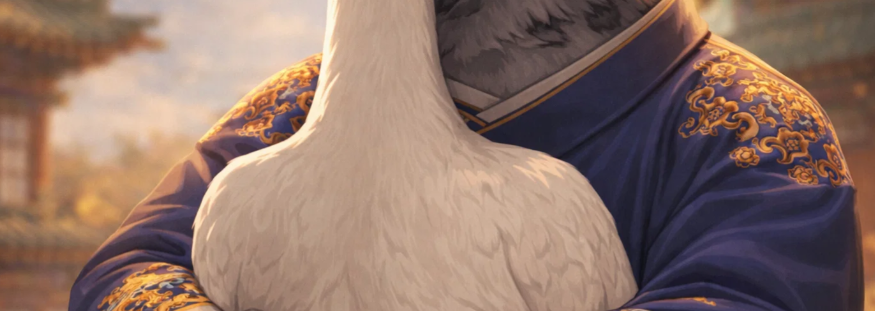
Tai Lung suddenly picked up Li Mei, flipping her around until her back faced him and kissed her on her pointy beak. Her wings flapped in laughter as Tai Lung seemed so joyful.
She thought Tai Lung couldn't be that bad to me... But... I don't know if I can feed a predator...
Tai Lung then nuzzled his head against her neck to the point where his neck touched her neck.
During Pre-Mating (Courtship)
Before actual mating, geese often engage in courtship behaviors that include:
Neck touching and rubbing — the male may gently nuzzle or rub his neck against the female’s neck and head.
Beak contact — a soft pecking or touching of the female’s beak or face area.
Body alignment — they stand very close side by side or facing each other, often with chests touching lightly.
Li Mei giggled, thinking... I felt like I wanted to leave him, but he's kind of cuddling me and all... I still have to leave... He's kind of a predator... I don't really want to, anymore... I can't believe the Dragon Warrior is this interested in me like that...
Then she looked down in sadness, Thinking... "I have to Give the scroll to Tai Lung..."
Handing it to Tai Lung, she says carefully, “Please don’t read it until I’m gone. I’ll be with my parents. It’s… just something important I wanted to tell you, but I don’t think I can talk about it right now.”
Tai Lung frowns. “Why not? We can read it right here.”
She urges Tai Lung not to. The letter is the equivalent of a Dear John letter—not a breakup, because there was never a relationship, but a rejection, a quiet explanation of why this cannot continue. She barely knows him. It is simply a this is not a good idea letter.

Tai Lung insists on reading it anyway and begins to open the scroll. Instantly, she closes it again.
“No,” she says firmly, “Please. Read it when I’m gone.”
His confusion deepens, and his tone sharpens, “I want to read it now.”
She takes the letter back without another word and leaves.
Tai Lung watches her go, baffled, and eventually returns to his home. That is exactly what she intended. If she leaves with the letter, Tai Lung will not follow. Even If he believes the matter is unfinished, he will not pursue her. Confusion, she hopes, will send him home instead.
Later, she goes to the place where Tai Lung lives with Master Shifu. She places the letter quietly on the doorstep, knocks once, and disappears before the door can open.
After that, she does not return. She withdraws completely, remaining inside her home, careful and unseen.

She is afraid—not without reason—of how a predator might react to a prey animal rejecting him, especially one known for his pride, volatility, and sense of entitlement.
Shifu retrieves the letter from the doorstep. He unfolds it, reads, and his expression slowly tightens.
The letter begins:
“This is Li Mei. My parents have told me that it may be better if I truly think through this relationship.”
She chose those words carefully. Tai Lung was known for irrational fits of anger, and she feared that if she blamed her parents directly, Tai Lung might kill them for interfering. She was genuinely afraid Tai Lung would eat them.
The letter continues:
“Please do not harm my parents. They had nothing to do with my decision. They encouraged me to consider the relationship, but they insisted that I think it through carefully. This choice is mine alone.”
Then she explains...
“I thought about our differences. You are a predator. I am a goose. You eat meat; I primarily eat seeds, grasses, grains, roots, leaves, and berries. Occasionally, I may eat insects or small fish, but my family is largely vegetarian. If I am not comfortable eating small animals myself, how could I prepare the food predators need to survive?”
Her writing grows more specific...
“You are a snow leopard. Your species hunts large and medium prey—blue sheep, wild goats, marmots, hares, pikas, rodents, game birds. When prey is scarce, even horses or young livestock. You survive on meat. As much as I care for you, I do not know if I could kill another animal for you, prepare flesh for you, or protect myself beside a large, powerful predator.”
Then comes the most difficult admission...
“I also do not know if I could share a bed with you. I learned how animals breed.”
This mattered more than she could explain simply. Snow leopards are solitary creatures except during mating season, which occurs in late winter, typically from January through March. During this time, males and females seek each other out, communicate through scent and vocalization, and mate repeatedly over several days. They reach sexual maturity quickly—around two to three years of age—far earlier than humans.
Geese are different.
Geese form long-term pair bonds, often for life. Courtship occurs in late winter to early spring. Nests are built near water, lined with grasses, leaves, and down. Eggs—commonly four to seven—are laid over several days and incubated for nearly a month. Both parents defend and raise the goslings, who can walk, swim, and feed shortly after hatching. Geese mature over years, not seasons.
Geese are one of the few bird species where males do have a penis-like organ. It’s relatively short and can be extended from the cloaca during mating.When not in use, this organ is retracted inside the body cavity and not externally visible — much like other internal organs.
She continues:
“I researched how snow leopards mate. My parents taught me the geese version of the birds and the bees. When I learned how your species breeds, I realized I am not built for that. I do not want that. My body is not made for it, and it could hurt me.”
Her fear becomes clearer...
“What would happen during your mating season? You may seek another leopard, guided by instinct, scent, and sound. What would I do then? And what if I were the one who felt drawn to someone else? I would control myself—I would have to—but what kind of life would that be?”
She does not accuse him, but she does not hide her truth...
“I know you may control yourself. But males have expectations, desires, instincts. I know you would want things I cannot give. I do not want to sleep with you. It makes me uncomfortable. I believe it would hurt me. This would not work.”
The letter ends softly, almost pleading...
“I am sorry, Tai Lung. I do not wish to offend you. I do not want to anger you. I only ask that you do not hurt me or my family.”
Shifu lowers the letter slowly.
The rejection seems... Kinda cruel in a way when it comes to the mating stuff. It is rational. Awkward, dangerously honest, and the way it is done may seem foolish. Li Mei is not wrong to fear sexual incompatibility, instinctive aggression, or physical harm. She is not wrong to protect herself.
What makes the letter dangerous is not its reasoning—it is that it was written to a man known to kill when rejected and... She mentioned that... She could never.... Mate with him... Yeah... Um... Heheh...
Shifu exhales sharply.
“Oh… no,” Shifu mutters.
Instead of taking the letter to Tai Lung, Shifu brings it to Master Oogway. Oogway reads it once, then lowers his gaze.
“This is not good,” Oogway says quietly.
After a moment, Oogway adds, “Do not give him this letter. He will crash out.”
Shifu understands immediately.
Rather than handing the letter to Tai Lung, Shifu approaches his son directly and asks, cautiously, “You were in a relationship?”
Tai Lung scoffs: “No. I wasn’t. I was going to be in one. We weren’t going to marry—just date. Keep it quiet. That way I could remain the Dragon Warrior and everything would be fine. You don’t need to worry about me.”
What is unsettling—what borders on tragic—is the certainty in his voice.
The relationship was going to happen. She wanted me. She would never leave me.
And if Tai Lung could not endure rejection from Master Oogway in the main storyline, how could he possibly survive another form of rejection?
Shifu looks at Tai LUNG then, truly looks at him, his expression heavy with grief.
“Well,” Shifu says softly, “she isn’t interested in you. She sent a letter. She rejected you.”
Tai Lung’s eyes harden.
“Excuse me?” Tai Lung snaps, “She would never reject me. I am the Dragon Warrior. There is no one she would want more than me. No other man. No other person. No one—not even Oogway. Not even you.”
Shifu feels it then—the danger.
This is a man ruled by pride, capable of violence, unable to accept rejection. Rash. Hot-headed.
This is not going to end well.
Tai Lung lacks the emotional control required to handle feelings of this magnitude. That is why a romantic relationship was always a dangerous idea for him—romance stirs hormones, attachment, and vulnerability Tai Lung cannot regulate.
The first crack appears when Tai Lung confronts Shifu.
“You must be lying,” Tai Lung says sharply, “She and I are meant to be together. I understand that you may not approve because she is not of my status, but she is perfect for me.”
Shifu answers without raising his voice...
“It is not a lie. She wrote it herself. It is written on a scroll.”
Shifu has hidden the scroll, knowing what Tai Lung might do if he found it. But Tai Lung is already spiraling.
Tai Lung begins searching—methodically at first, then with growing urgency. Tai Lung does not destroy the room or tear it apart. This is not blind rage yet. It is frantic, focused, driven by obsession rather than chaos. Tai Lung does not know her well enough for grief—only for wounded pride.
Eventually, Tai Lung finds the scroll.
Tai Lung reads it.
And it infuriates him.
Tai Lung thought, “I protect everyone; how dare she reject me.”He didn't know her too well, but this rejection made him go off because...
A. She told Tai Lung that she was scared to breed with him...
Although, if Tai Lung is not careful, he might kill her due to how heavy he is.
yOU SEE, Adult male snow leopards typically weigh roughly 75–120 lb (34–54 kg) in the wild.
They’re powerful predators adapted for rugged mountain terrain and can take down very sizable prey relative to their own size.
Chinese geese are relatively lightweight domestic geese. Adult females typically weigh about 8–10 lb (3.6–4.5 kg).This small body size and their anatomy (long neck, narrow body) means they aren’t strong load-bearing animals. Geese don’t have the skeletal or muscular structure to support extra weight on their backs without risk of injury.
Chinese geese are not suitable for carrying weight. They’re bred for foraging, egg production, and ornamental/homestead purposes, not for load-bearing work.Trying to put weight on a goose’s back could injure its spine, legs, or wings, even if the goose itself weighs only about 8–10 lb (≈4 kg).
If he laid upon her during mating, that 75-120 lb could be too much for her, so her concerns -- all of them -- are technically valid.
He'd have to be gentle if Tai Lung wanted to mate with her.
B. Tai Lung is not emotionally stable.
Shifu told him that "She doesn't even know you that well... How long have you known her?"
Tai Lung had known lI mEI for just a few weeks, maybe about 5 weeks or so. Tai Lung knew lI mEI as a woman who was very pretty, and from an esteemed family. While not rich, the father was very popular among the people. they were close to an upper middle class income, to be honest.
To Be Continued...


Comments